Over the last 6 months while on maternity leave in a lockdown, I’ve really been reflecting on purpose and conscience; my own and how is it relevant to the role of a lawyer. Quite big topics!
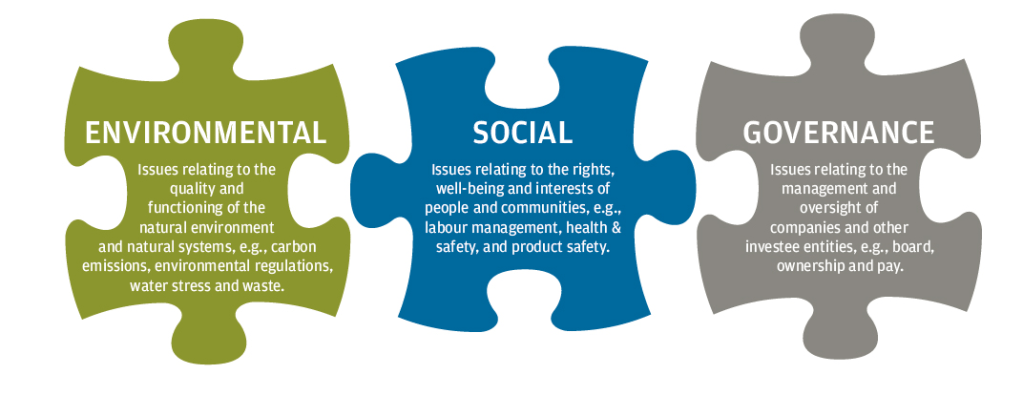
I have also found a natural curiosity and have been exploring the world of Environmental, Social and Governance (ESG) roles and the subject matter around it. It can mean how sustainable a business is; a way to measure the sustainability and social impact on an investment; and the environmental, societal and governance factors which are taken into account in business processes and decision making. It’s not only about responsible investing but a responsible business model.
I read about ESG measures at least once a day on my go to news sites and media platforms which tend to be Bloomberg and now hooked on the recently launched Bloomberg Green, the Financial Times, The Economist, The Grocer and I also find a lot of relevant content on LinkedIn.
While it’s not blatantly obvious yet and we aren’t seeing an explosion of ESG Counsel roles in the UK at least, my prediction is that pretty soon we will. The big global firms are ahead; Clifford Chance LLP, Linklaters LLP, Freshfields and CMS to name a few but I mean businesses and the more regional firms. Lawyers, both private practice and in-house Counsel have the skills, the accountability and strategy to effectively support businesses make real change.
What do I mean by ‘real’? Well there is a big difference between saying something and actually doing what you say. The ‘real’ action has to be tangible, measurable and the output must meet the objective. There’s a recent article in the Financial Times https://on.ft.com/3pHgfm8 which raises concern by Larry Fink (CEO of BlackRock) that many boards lack the competency to deal with climate change and sustainability because there just aren’t enough experts on the wide and varying subject matter. This makes it impossible to understand how this can really impact a business.
In 2020 Microsoft announced its aggressive zero net targets for 2030 while Amazon also announced its audacious ambition to achieve net zero carbon by 2040 (10 years ahead of the Paris Agreement). However, Amazon have publicly admitted it doesn’t quite know how it’s going to get there. I like that level of honesty.
The saying and the doing in this space is going to be one of the biggest challenges ever faced by businesses with all eyes watching.

So what skills do lawyers have that can support businesses navigate their ESG road map and why should they be given the role of the gate keepers?
Horizon Scanning
Part of a lawyers job is to always be looking ahead and scanning the horizon for opportunity, risk, threats and ways to improve greater compliance for a business, but let it move at the lightning pace it wants to. If you’re an in-house Counsel, it can be a challenge to keep up. The business landscape, regulations and how businesses conduct themselves is fast evolving. In recent years I’ve led and implemented a variety of new legal instruments into my business: The Modern Slavery Act 2015, Criminal Finances Act 2017, The General Data Protection Regulation 2016/679 (GDPR) and Consumer Rights Act 2015 just to name a few. An ESG Counsel will be able to identify and articulate ESG risks and ensure these are effectively managed by incorporating them into the corporate management, adequate protocols and policies.
The ability to influence at decision making level
It is always good hygiene and one of ethics to have your Counsel participate at Executive level. It is for a business’s own protection for one; not to mention from an operational perspective the insight Counsel can provide across business activity. From an advisory perspective too it is recommended to ensure the senior management adheres to guiding legal principles and conducts business consistent with that of all legal requirements.
If you haven’t read ‘A Colossal Failure of Common Sense: The Incredible Inside Story of the Collapse of Lehman’ by Larry McDonald I recommend it. At the time there were lots of questions; where were all the lawyers? The account reveals the weeks leading up to the collapse of the Bank, the Board uninvited the lawyers to all subsequent meetings…
ESG is a wide topic; its ensuring your business is free from slavery and ethically looking after your employees. It’s looking at your supply chain and procurement strategy to assess environmental impact and risk (i.e removing single use plastics for example). It’s advising and influencing your Marketing Director how they need to advertise responsibly but in a way they realise consumers still buy into a brand with a deeper conscience and desire to impact social change and you’re not just delivering one dimensional legal advice.
Governance and Accountability
While supporting a business, Counsel’s are usually the ones to challenge the business, decision making, policies and it all plays into ensuring all views are considered and accountability is not forgotten. Of course, you are truly accountable to your shareholders but lawyers can really make a business think a bit differently on how to articulate or present a policy or principle at an early stage. ESG requires the same level of consideration and steer from a corporate governance point of view. Ultimately ESG measures and factors will need to be presented to investors and it’s such a hot topic it’s what investors now really want to know about because it can add value or devalue your business.
Risk Assessment and Risk Mitigation
In-house Counsels need to be comfortable operating in grey territory as part of the in-house advisory role. The language you converse in, the relationships you hold and the ability to protect while support your business as an in-house Counsel is quite unique and different to that of the private practice v client relationship. A risk based approach and with that risk mitigation is a crucial skill to develop, articulate and put in place. ESG risk and how they’re dealt with could determine whether an investor withdraws their funds. Or, anticipating risk could help a business decide what materials to produce their goods with which could have significant cost impacts or how to transport the goods for example by freight or electric vehicles.
The Legal Framework for ESG reporting
Currently, there is isn’t a global, US or European standardised regime to establish ESG reporting levels and what compliance should legally look like to achieve strong ESG status. However, new European regulations, a sign of its commitment to responsible investing will help to really distinguish those companies deserving of the status.
In 2020, the European Council signed the EU Taxonomy Regulation which is intended to really consider environmental, social and governance factors and will replace voluntary schemes. There is also the draft Non-Reporting Financial Directive which will require large EU corporate businesses with a public interest (including many financial services firms) to publish data on the impact their activities have on ESG factors by way of disclosure.
My feeling is if you’re wondering where to place ESG within a business and not every business has the resource to create its own teams despite its serious commitment to sustainability, turn to your legal team. Lawyers are, smart and skillful and above all ethical and have a deep conscience to do the right thing. To do good. I know I do. They tend to be trusted advisors to the inside world and able to protect the business from outside threats. Compliance runs deep throughout ESG so it makes sense to couple the ESG role with that of your legal team and I predict in the next few years we are going to see a lot more ESG Counsels. I hope so.