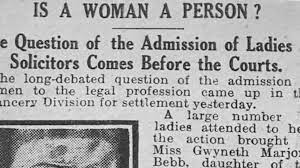
Women were not included in the word ‘persons’ for the purpose of the Solicitors Act 1843.
I went to a ‘Women in Leadership’ event hosted by PWC some time ago and met some formidable women; General Counsel’s and CEOs. Moya Greene was there and shared anecdotal stories of her time as the first female CEO of the Royal Mail. Anyway, as inspiring as the event was it was overshadowed when one high profile General Counsel revealed during her law career in some city law firms there were no female toilets…. I mean they weren’t same sex toilets, there were only ‘male’ toilets.
This tiny extract of learning from women before us paves the way for us to shout about ‘Women in Law’. Why are there so many groups, discussions and women who identify as being a ‘woman in law’. Why does a ‘woman in law’ sound strong, bold, courageous and defiant… because it is, with good reason.
It’s not just about the washroom. It’s also not just because women in law decided to set themselves apart or to try and create any sort of superiority over other women, it is because, in my view there is an obligation for women who take on a legal profession, to continue to remind the profession that this was not always the case.
Breaking down the barrier
There was once upon a time when it was illegal, actually illegal for women to practice law. This was a global fundamental discrimination against women and no doubt feels deep rooted in many females today.
Historically, the legal profession has been a tightly controlled community for both Solicitors and Barristers, paving the way for a lack of diversity or opportunity. A community for only those who could afford the route to qualification, who had the right private school on their application and a community who closed the door on women and ethnic minorities.
It wasn’t until 1919 when the Sex Discrimination Act was passed in the United States and The Sex Disqualification (Removal) Act 1919 in England was passed, that women could practice as a solicitor, sit as a judge and serve as a juror. It was The Solicitors Act 1843 that allowed for ‘persons’ to be admitted as solicitors. However, when challenged by a woman called Gwyneth Bebb the Court of Appeal claimed the word ‘persons’ should not be interpreted to include women.
103 years later
In the last 103 years now, there have been so many women in law who have pioneered for equal rights, not just as legal professionals but to eradicate discrimination based on gender everywhere. The last two decades also saw Lady Hale become the first woman Lord of Appeal in 2004, the first female justice of the UK Supreme Court in 2009 and the court’s first female president in 2017. Lady Hale has been vocal about the judicial system and the inherent bias that exists in producing a judiciary that is “not only mainly male, overwhelmingly white, but also largely the product of a limited range of educational institutions and social backgrounds”. I’ve just finished reading ‘Spider Woman’ by Lady Hale and I recommend reading it; the woman has style.
She also hit the nail on the head. Wealth. When I was trying to qualify as a lawyer I felt this first hand; I wont say the name of the city firm I was interviewing at for a training contract, the gold dust, the land of milk and honey (ok, it was the then Cameron McKenna). The first 3 questions I was asked by the Partner;
- What school did I attend;
- Where did I grow up;
- What did my parents do.
What he was actually asking was…. ‘do you come from money’. The answer was no. Anyway, the door closed for whatever reason. There were multiple unpleasant experiences in particular thereon, on the basis of sex, that really put me off a career at a city law firm.
Face forward
Of course, this post does not reflect the gender landscape of today. There has been a radical change of demographic representation in the legal profession which by the day is growing more diverse and inclusive.
I will always be grateful for the last 103 years, to the champions, for those who did raise their voice to fight for gender equality but recognising no doubt whether due to social, ethnic, tradition or another bias not everyone has been able to fulfil a passionate career in law due to the barriers that can still exist even today.
The First 100 Years Project
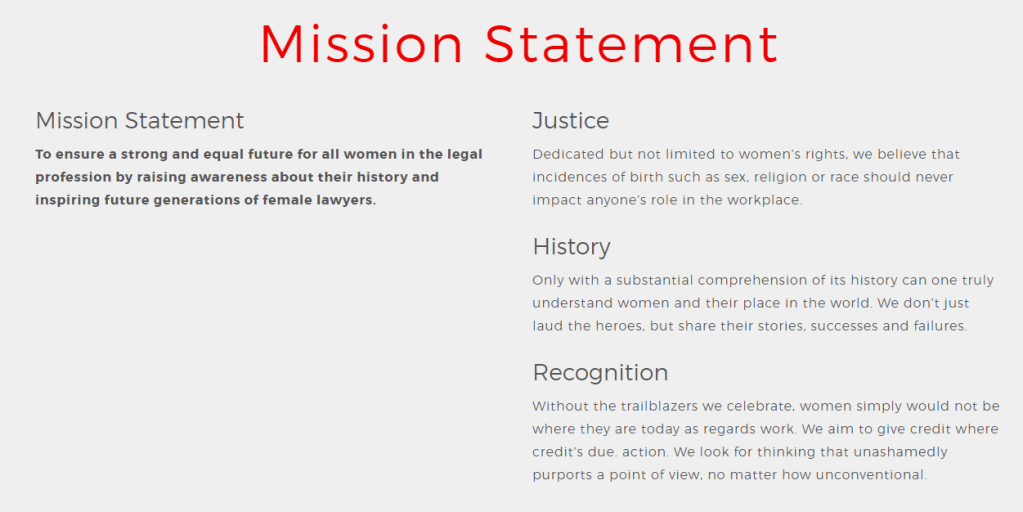
If you don’t already follow The Next 100 Years on Linkedin I recommend it. With a fundamental mission to ensure an equal future for women in law it also celebrates the last 100 years and the icons during that time who helped to remove barriers, to enable us today to be a woman in law.
While so much progress has been made, there still exists gender bias.
According to the latest research compiled by The First 100 Years project, a celebratory campaign to mark the year when women could first practise law, over half of respondents (54%) said they receive encouragement from senior women in the workplace but that a failure of employers to accommodate the “realities of family life” continued to hold women back.
According to the Law Society women now make up 50.1% of practising solicitors 103 years later. However, women still only represent 28% of partners in private practice with the figures for equity partners even lower.
While I choose to celebrate and embrace how women have contributed to breaking down barriers to the legal profession, it is with a heavy heart it is against the backdrop of even having to talk about it as if we won our case.
We should never have had a case to fight.
 canyouhearme.blog