“Everyone has the right to live a life free from slavery”
Anti-Slavery International
Slavery is prohibited on a global basis, yet it still exists on our doorstep, here in England, in cities, villages, companies, families. More than we know it more widely still exists within the G20 countries and can be fuelled by violence, an imbalance of power, corruption and for commodities such as cocoa. The leading UK charity Anti-Slavery International has declared modern slavery is present in every single part of the UK. It’s a huge topic and quite frankly the statistics and figures on both global and UK modern slavery overwhelm me.
I started writing this blog piece about modern slavery weeks ago but honestly is frightening the more I read the bigger the topic and my research just snowballed to no end. One of the key facts I read is that it is virtually impossible to get an accurate size of the modern slavery problem from any single source as confirmed by the Office of National Statistics due to it’s unseen and hidden nature.
It’s hard not to feel the heart sinking emotion on this subject as it comes from so many different angles from children to gender exploitation and Covid-19 just made an extremely vulnerable situation worse for many.
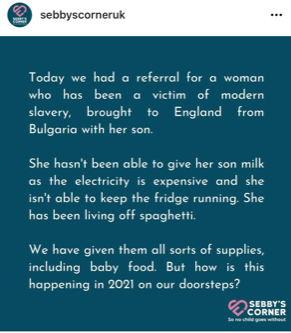
I read something on my Instagram that broke my heart. The London based children’s charity I follow and support, Sebbys Corner posted a unimaginable request for help. With their mission that no child goes without, they posted a plea for help on behalf of a woman who had been brought into the UK from Bulgaria under conditions of slavery. She couldn’t feed her baby, had no food or electricity to even run a fridge to keep baby milk. Sebbys Corner declared this was one of the most devastating requests for help they had seen in London but thank goodness for Sebbys Corner.
Within 24 hours many compassionate followers including myself had purchased Asda vouchers and items from an Amazon Wish List that was set up. This was potentially a life or death scenario for a mother and her child.
The 2018 Global Slavery Index, the most comprehensive ever study on the issue, estimates that there are 136,000 people living in modern slavery in the UK today.
Admittedly, I’ve only ever considered modern slavery through the lens of a commercial business; supply chain examples, knowing how to identify red flags with customers, suppliers or any other third party. I train all employees on the topic which is fairly high level, I advise the Board and review, update and publish our mandatory Modern Slavery statement routinely with the optimism that modern slavery doesn’t touch upon such sophisticated companies.
Then I stepped back from the commercial lens and I looked at the social landscape in the UK and all the different examples of modern slavery. I felt so sad the problem only seems to be growing and impacting more and more vulnerable victims.
Strengthening the Modern Slavery Act in the UK is the right direction
The UK Modern Slavery Act 2015 (MSA) categorises modern slavery offences into different definitions:
- Slavery, servitude and forced or compulsory labour (Part 1(a) MSA 15). Forced labour means any work or service which people are forced to do against their will, under threat of punishment. It includes debt bondage which occurs when a person is forced to work to pay off a debt and is the most common method of labour exploitation, accounting for about half of all victims of modern slavery.
- Human Trafficking (Part 1(b) MSA15). Human Trafficking means the process of trapping people through the use of violence, deception or coercion and exploiting them for financial or personal gain.
The MSA has arguably lacked real enforcement teeth to hold to account the companies who are lagging or not complying with their annual reporting requirements.
Some welcoming news from the Government came in in September 2020 whereby it published an ambitious package of changes to strengthen and future-proof the Modern Slavery Act’s transparency legislation, including:
- Extending the reporting requirement to public bodies with a budget of £36 million or more, a global first;
- Mandating the specific reporting topics statements must cover;
- Requiring organisations to publish their statement on the new Government digital reporting service;
- Setting a single reporting deadline on which all modern slavery statements must be published
- In addition, in January 2021, the Government also committed to introduce financial penalties for organisation who fail to meet their legal obligation under Section 54 of the Modern Slavery Act (not yet enforced by law); and
- In March 2021, the Home Office launched a digital modern slavery registry. The registry will enhance transparency by enabling investors, consumers and civil society to scrutinise the action different organisations are taking to prevent modern slavery and monitor progress over time.
The Global Landscape
The UN Guiding Principles on Business and Human Rights (UNGPs) was the first international reference framework on human rights in the context of business. Adopted by the UN Human Rights Council in 2011, the UNGPs placed on the international agenda the issue of identifying potential adverse impacts on human rights by business activity. The UN Sustainable Development Goals (SDGs) and in particular Target 8.7, which calls for effective measures to end forced labour, modern slavery, and human trafficking, as well as child labour in all its forms, has further contributed to the push within the international community to eradicate modern slavery.
The key message is that modern slavery may exist on your doorstep and can be much harder to identify because it can go hidden and can be far from the depiction of slavery one might have in their mind.
For example, we may identify slavery more closely with countries such as Cambodia, the Central African Republic or Pakistan or South Sudan as it is so prevalent, inherently existing within the culture and is passed down through generations. These are very obvious forms of slavery which the Global Slavery Index 2018 research has indicated are closely linked to conflict and highly repressive regimes.
Such forms of slavery make it impossible for slaves to acquire land, for dowries to be paid in marriage, to inherit land and it forces women into arranged marriage. On the other end of the transparency spectrum, how do you identify a woman who doesn’t speak English, brought into the UK by her brother and forced to work in the ‘family business’ to pay off the cost of her transport to the UK?
Modern Slavery and Gender Inequality
“Modern slavery is driven by power imbalances which, for women and girls, is exacerbated by gender inequality and discrimination.”
walkfree.org
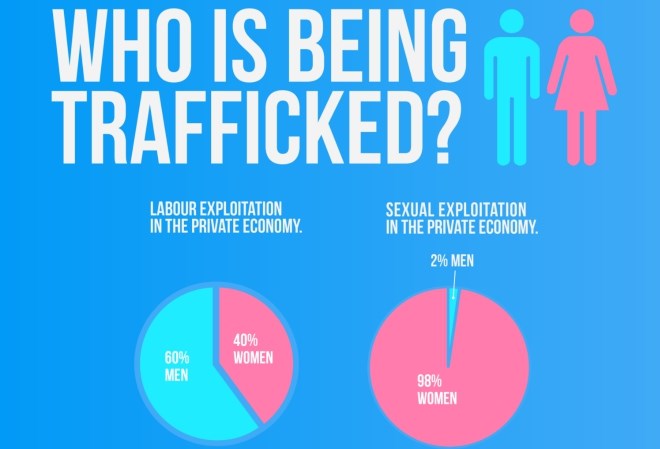
One of key issues you can’t escape the more you read is that modern slavery has a fundamentally oppressive impact on women. Gender-based discrimination and violence, and educational limitations for girls, make women and girls especially vulnerable. That’s not to say men aren’t effected; according to a report published by the Home Office men are more susceptible to labor exploitation, as men tend to carry out more physical work, but women by far are more likely to be victims of domestic servitude, and sexual exploitation.
According to the Anti-Slavery International Charity, 71% of overall victims of modern slavery, nearly 30 million – are estimated to be women and girls yet only 63,000 victims of slavery were reported to the authorities between 2012 and 2014 – that’s roughly less than 2%.
The Home Office report demonstrated examples of domestic servitude including women being forced to undertake household chores for their husbands, and in some case their husband’s families. They sometimes also experienced sexual exploitation. They lived with their husband in the family home, nothing unusual looking about that. Methods of control used were physical and sexual violence, surveillance and restriction of movement, and emotional control. That is modern slavery. That is slavery.
Another global charity based in the US Free the Slaves also focus largely on gender inequality and modern slavery. Much of their focus is at community level targeting the most challenging situations of vulnerable women and children and adopting what sounds like it should be so simple to achieve but isn’t; it’s freedom. They aim to educate residents about gender rights and empower women and girls to exercise those rights to reduce the risk of enslavement.
Being Hopeful
I really want to be hopeful about the future, that all forms of slavery can be overcome no matter how they exist or where, or which gender is more impacted. Right now though I am just saddened about so much that I’ve read. Yet there are real beacons of light and hope whether I’ve read about criminal convictions, women who have broken away from domestic servitude at the cost of ‘family’ but are making their own income; or understanding more about what the UK government is doing to strengthen the law surrounding this topic.
One thing I know is that when I see a plea for help on my Instagram, I don’t just scroll down….
 canyouhearme.blog