The topic of female quotas is not a new one since gaining momentum back in 2010 when the European Commission suggested legislative action. Two years later it proposed a Directive with a target to reach 40% women on executive boards. Disappointingly no agreement was reached on the proposal (largely due to opposition from Central and Northern European member states including the UK) though several EU Member States took proactive measures to improve gender-balance in economic decision making.
France remains the only Member State with at least 40% of each gender on the combined boards of the companies covered; a figure first reached in October 2016 following the adoption of a 40% legal quota in 2011. This quota is applicable to companies with more than 500 employees or revenues over €50 million.
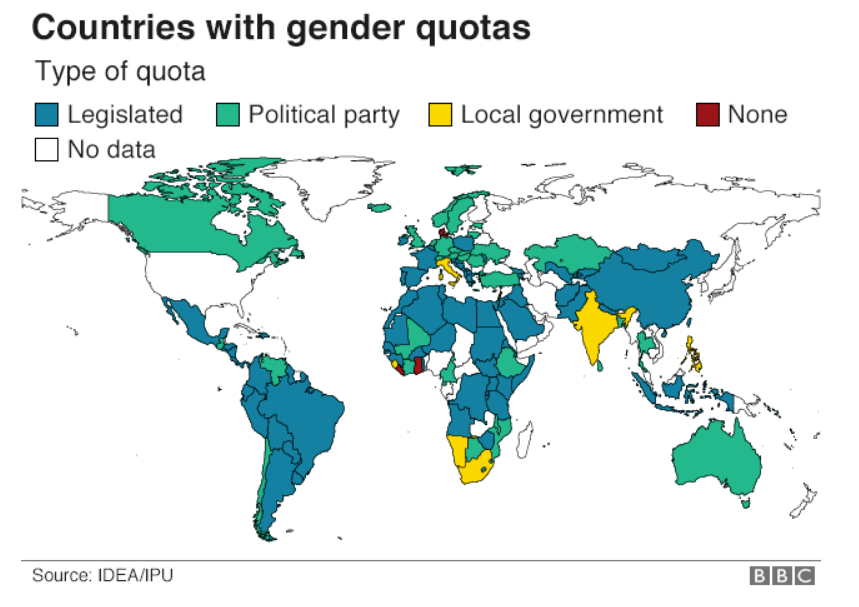
Other countries where there is more balanced representation (and I mean a third) of women in the board room as a result of legally binding quotas include Portugal, Italy, Belgium, Austria and Germany. There is always a lot of talk about board level quotas and female representation and while companies may boast a strong position at the executive level, it’s more likely that at senior level (for the sake of this blog that includes roles ‘head of, director, senior VP, manager’) there is a significant drop in women.
In the UK there is the independent review body; the Hampton-Alexander Review which builds on the work from the Davies Review; to increase the number of females on FTSE 350 boards.
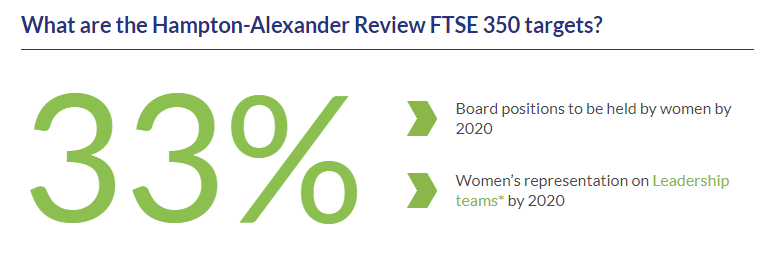
This is the closest, target driven call to action the UK has without being legislated and its entirely voluntary and business led.
In February 2020 the FTSE 100 index reached 33% , almost a year ahead of the deadline with 349 women on FTSE 100 boards out of a total of 1046 directorships. While it’s not been finalised there’s a very good chance the FTSE 250 index will also achieve the target by the end of 2020. Not bad! No problem then? Sadly, I feel like 33% is our lot, that’s all we can hope for and that is even considered success. Do we dare to strive for parity and how many decades will this take?
According to the European Institute for Gender Equality, in April 2019, women accounted for just 18% of senior executives compared to 30% of non-executives. Surely 9 years on, these figures indicate there is still a need to implement legally binding quotas in some countries to pull business culture out of this sluggish attempt or even token effort to improve female representation at senior level? It’s great to see improved female figures at board level don’t get me wrong, but if it’s not being absorbed into company culture and being deep rooted in to the core values of a business, there will not be a proportionate number of females at all levels… we need to look beyond the board room.
Also, where do the women go and why? This is crucial to address to ensure companies have the fit for purpose culture and policies to support women through not only career development but also personal life and character development. This to me, is arguably the key to success over quotas. But that topic’s for another blog…
I first came alive to a business genuinely trying to address this issue while working as a lawyer at Unilever UK in 2012, a company close to my heart. We were a force of ten women in the legal team led by our General Counsel, a male who sat on the Senior Leadership Team. At the time Amanda Sourry was the UK Chairman, a woman I really admired. She was the most pleasant and approachable woman, always smiling; confident and spoke with such confidence and energy, our monthly town halls were always full.
By 2016, there were 3 females on the Leadership Excecutive Team at Unilever. They are described as ‘3 of the most inspiring women in Unilever’ one of which is the Chief Legal Officer. It’s a great example of how even the largest companies don’t define their success in gender equality through binding quotas. Rather they have the infrastructure to support this.
I was encouraged to see this topic has not fallen on deaf ears despite the slow progression. The European Commissioner for Equality, Helena Dalli is launching a 5 year gender equality strategy. The commission argues that gender parity is most worrying in the sphere of power, with women underrepresented in politics and business. Dalli is also a strong force in introducing legislation to bridge the gender pay gap in the EU and I am going to follow the topic with interest as the legislation is proposed to Brussels at the end of 2020.
I don’t take a hard line when it comes to legislating for females quotas; I do recognise the strides and the attempts that have been made most of all in the UK. But the change is slow; it lacks momentum and pace that legislation could resolve. I do however believe a balanced conversation needs to be had at executive and board level and that can only happen with a fair representation of women present at the table.
I think many women actually would support the enforcement of quotas; not because they want to be awarded a role based on the a requirement and the stigma that might be attached to that but for the benefit of the broader landscape in supporting gender equality in business. Once you get invited into the room, there is plenty of opportunity to establish your influence and role but we need to ensure the door is legitimately open to all.
 canyouhearme.blog