“My mother told me to be a lady. And for her, that meant be your own person, be independent”
“Women will only have true equality when men share with them the responsibility of bringing up the next generation.”
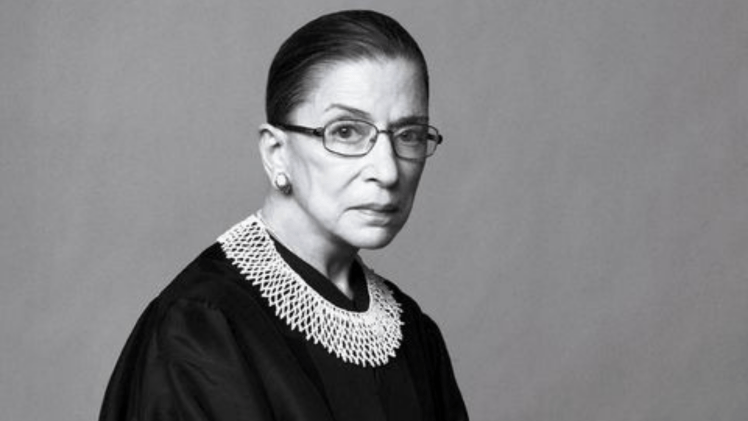
The acronym RBG went viral digitally like we refer to it at the pub. Following Ruth Ginsberg’s death, there were T-Shirts on Amazon, all sorts of merchandise for sale and Twitter was working on overdrive to publish global obituary’s from celebrities, politicians and more. Since when were judges and lawyers ever spoken about so much or of any real interest to social media users?
She was often referred to as ‘The Notorious RBG’ and ‘the great Dissenter’. Bille Jean King described her as ‘my hero’; Hillary Clinton posted on Twitter ‘there will never be another like her’; and Elizabeth Warren referred to her as ‘Ruthie…an icon’.
Since her 1993 appointment as an Associate to the Supreme Court by Bill Clinton, Ginsberg participated in landmark cases that covered issues ranging from abortion rights, native Americans, voting rights, gender discrimination and same-sex marriage. She was a high profile member of the Supreme Court, the first Jewish woman and only the second woman to take the bench. Ginsberg really found her voice following the retirement of Justice Sandra Day O’Connor leaving her 1:8 ratio of women to men sitting on the Supreme Court. Not only was she famously known for disagreeing with the judgments of her colleagues but, she went further to express her disagreement on occasion by reading out dissenting opinions from the bench ensuring the unresolved issues were clearly highlighted.
This was a lady who was not scared to act with conviction, who didn’t follow the majority for fear of being singled out and who consistently stuck to her own liberal values and beliefs, all in very much a man’s world. She lived through her own experiences of gender discrimination having to argue why her Harvard Law place shouldn’t have been given to a man. When asked when will there be enough women on the Supreme Court, she replied ‘when there are nine’. Man, would I like Ginsberg on my bench.
The death of Ginsberg is now exposing to the world the very real threat that exists in the United States judiciary, where the rule of law is undermined and ultimately dictated by politics at the highest level. Historically however, the Supreme Court has been looked upon more favourably than not in its decision making, let’s see where public opinion will go post-election. I always thought a country with a written constitution would allow for much more objective interpretation of the law with more consistent application but that is simply not the case. With a document dating back to the 1700s thrown in with strong political agenda in 2020, it’s clear there is still much room for threat and manipulation in the US judiciary; what’s more important the ‘then’ or the ‘now’?
There is more discussion than ever on judges political views, between Republicans and Democrats and growing concern that the Supreme Court is gaining too much power in favour of right wing views which threatens the interpretation of the Constitution. Following Trump’s nomination of Amy Coney Barrett as Ginsberg’s successor and listening to the current confirmation hearings, there is a lot of focus on Judge Barrett’s values and views. Her political views we know little of (which is not uncommon for lawyers to not openly promote) but another conservative on the bench has the potential to be of real concern for US civil rights law.
It comes as no surprise therefore that there has been an enormous reaction to Ginsberg’s death. Worryingly, despite there being 8 other judges that should arguably be of equal imminence, she was known to be the tipping point in decision making, decisions of SUCH enormous importance determining an individual’s freedoms, so what were Ginsberg’s most notable cases?
Sex Discrimination
Ginsberg challenged the different treatment between men and women in the 1970s in a variety of cases as being unconstitutional. Prior to 1974, women weren’t entitled to have their own bank account or a credit card (unless they were single) and were added as supplementary user to their husbands accounts. As a result of such growing pressure The Equal Credit opportunity Act, 1974 was established making it illegal to discriminate against a borrower “on the basis of race, colour, religion, national origin, sex, marital status or age in credit transactions.”
United States v Virginia, 1996
Ginsberg left a legacy that paved the way for women. In the key case United States v Virginia, [1996] a case which successfully challenged the policy of Virginia Military Institute because it forbid women from being admitted to the institute. Ginsberg wrote the majority opinion stating ‘Neither federal nor state government acts compatibly with equal protection when a law or official policy denies to women, simply because they are women’. Ginsberg made it clear; that gender equality is a constitutional right.
Ledbetter v Goodyear Tire & Rubber Co, 2007
In Ledbetter v Goodyear Tire & Rubber Co, [2007] the claimant, a female worker was paid significantly less than a male of the same qualifications. The case was not upheld due to a technical statute of limitation imposed on such cases being brought; that the statute of limitation for bringing an equal-pay case begins on the date the employer sets the wage. Ginsberg determinedly dissented, reading her opinion from the bench and then worked with President Obama to pass the first piece of legislation he signed which was the Lilly Ledbetter Fair Pay Act 2009. The Act amended the Civil Rights Act 1964 so that the 180 day limitation to bring such a claim resets with each pay-check affected by that discriminatory action.
Obergefell v Hodges, 2015
In 2015, Ginsberg heard Obergefell v Hodges [2015], a law which impacted multiple states that banned same-sex marriages. Ginsberg supported the majority unwaveringly which was won 5:4. The Supreme Court ruled that the fundamental right to marry is guaranteed to same-sex couples in every state of the US.
Ruth Ginsberg leaves a legacy that women still stand strong for but the fight continues. The gender pay gap is still an ongoing and unresolved conversation and no adequate conclusion in England. Next time you take out your credit card, remember Ruth Ginsberg made it possible for American women to use one in their own name.
She dedicated her life and career to ensure men and women are treated equal under the law, as it should be. I really respect and relate to her approach of feminism; she had a strong voice and used it without shouting; she articulated her point without bringing down males and was relentless in her commitment to her own values, the law and that of what the Constitution intended.
 canyouhearme.blog